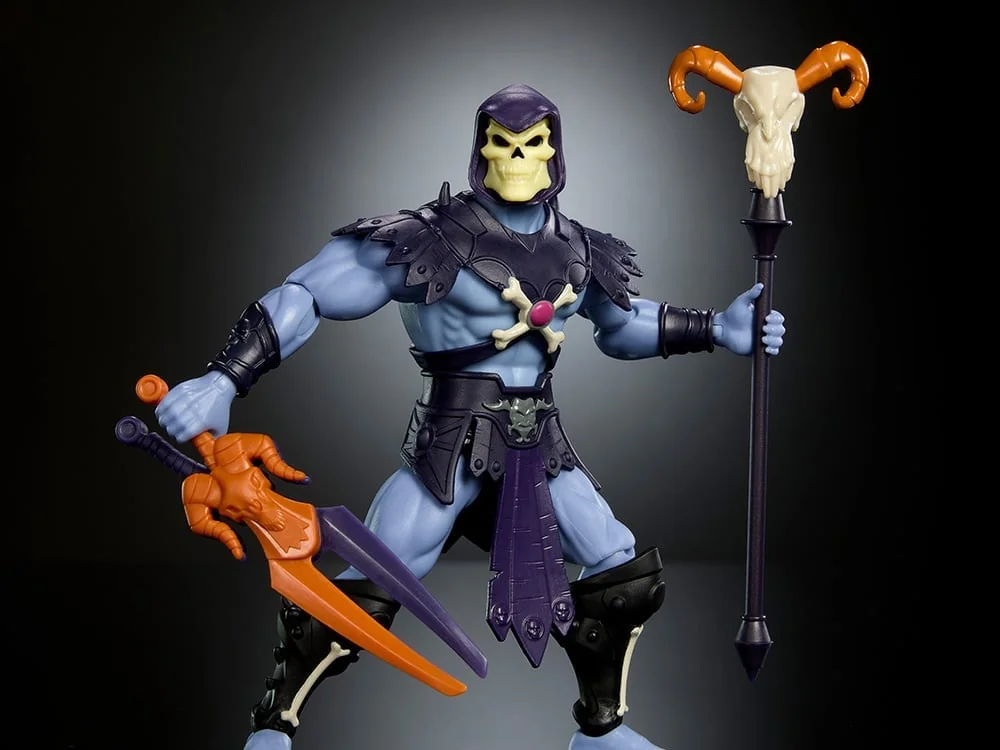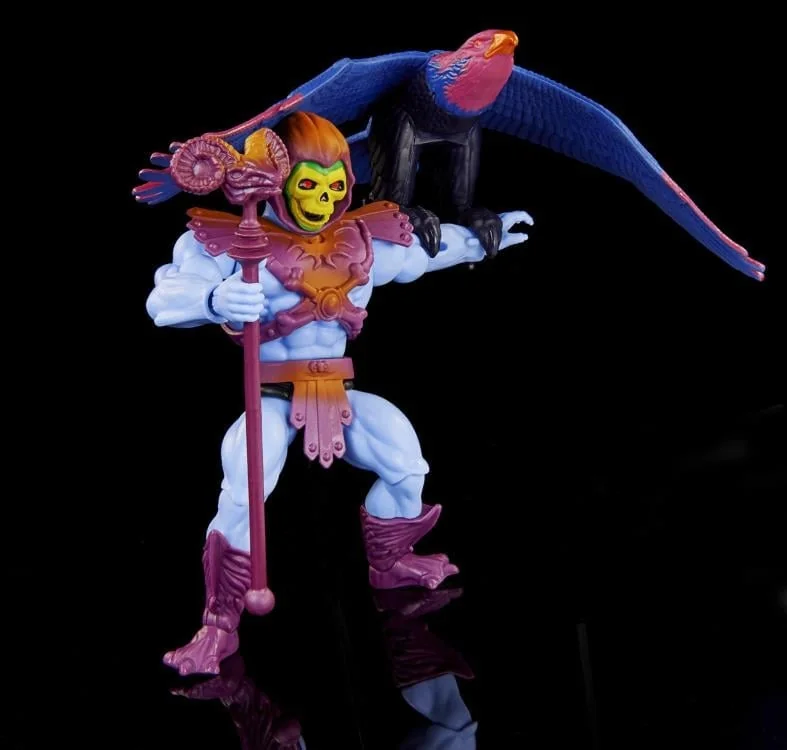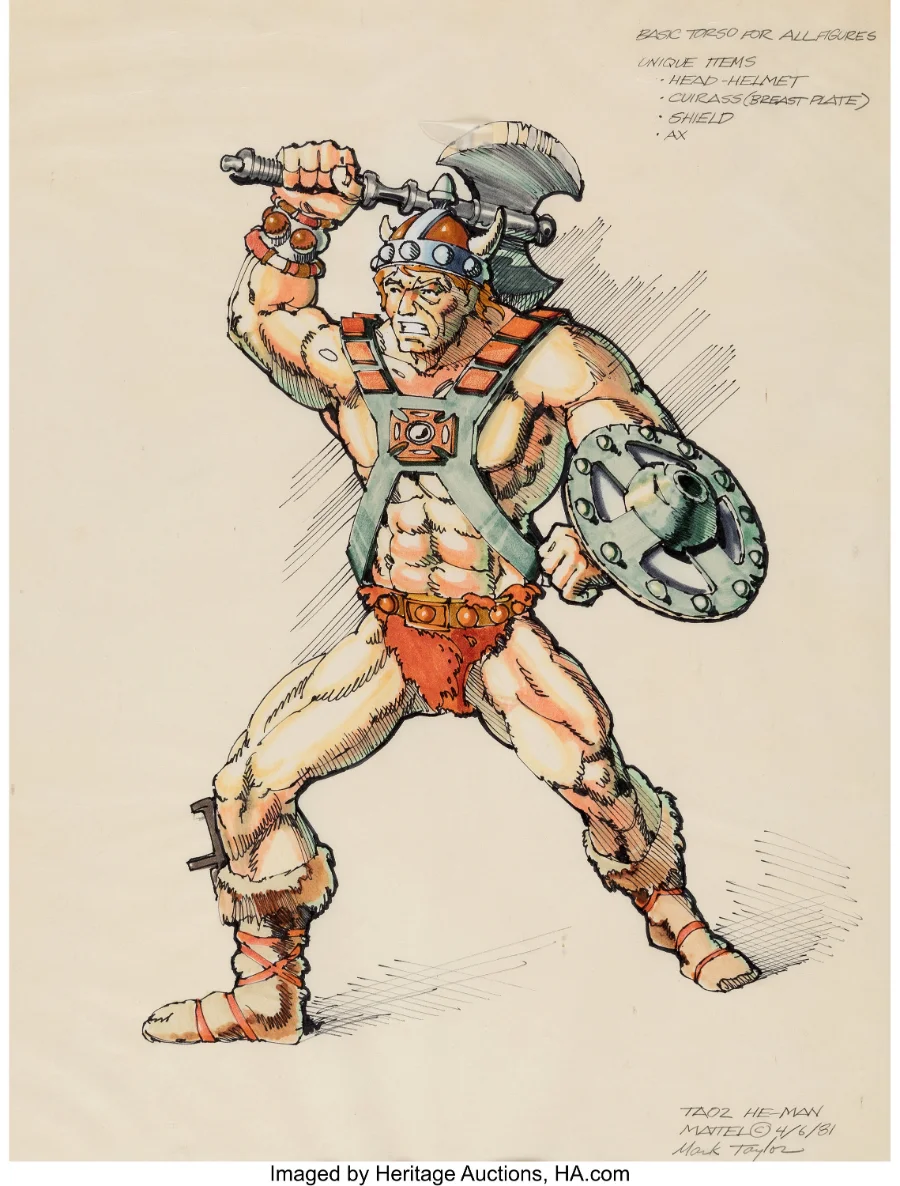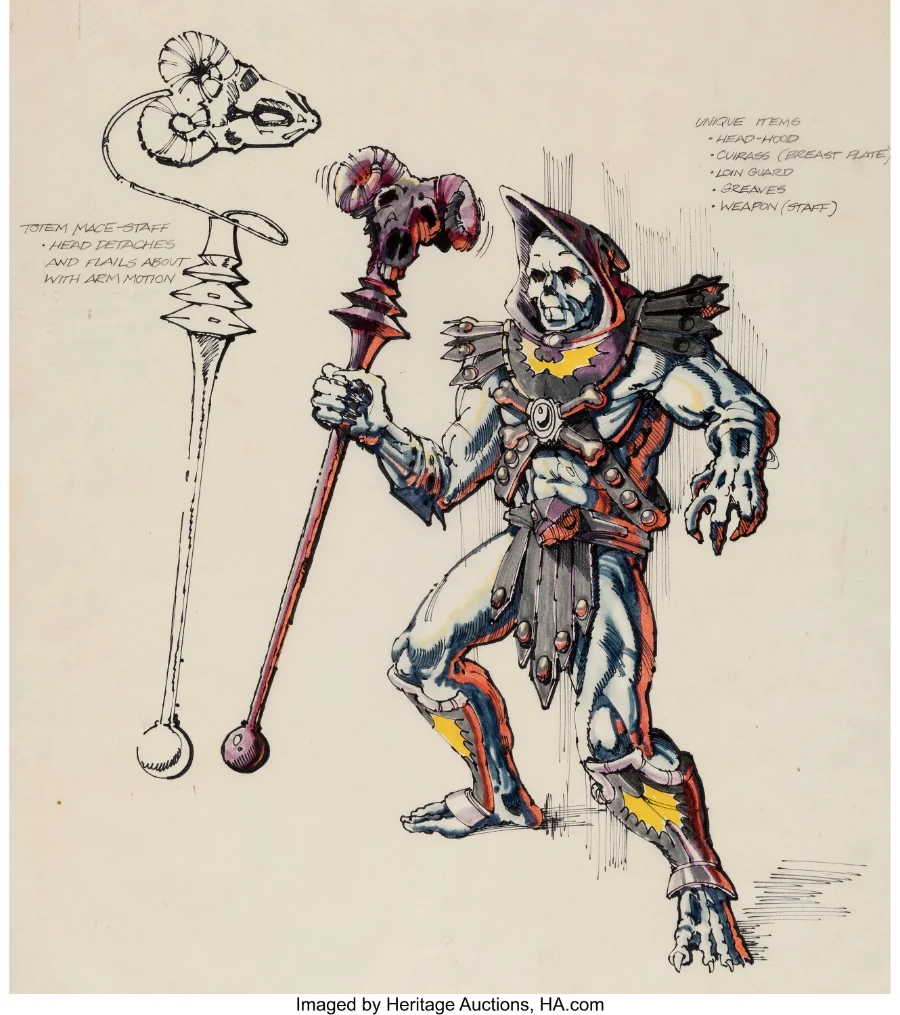
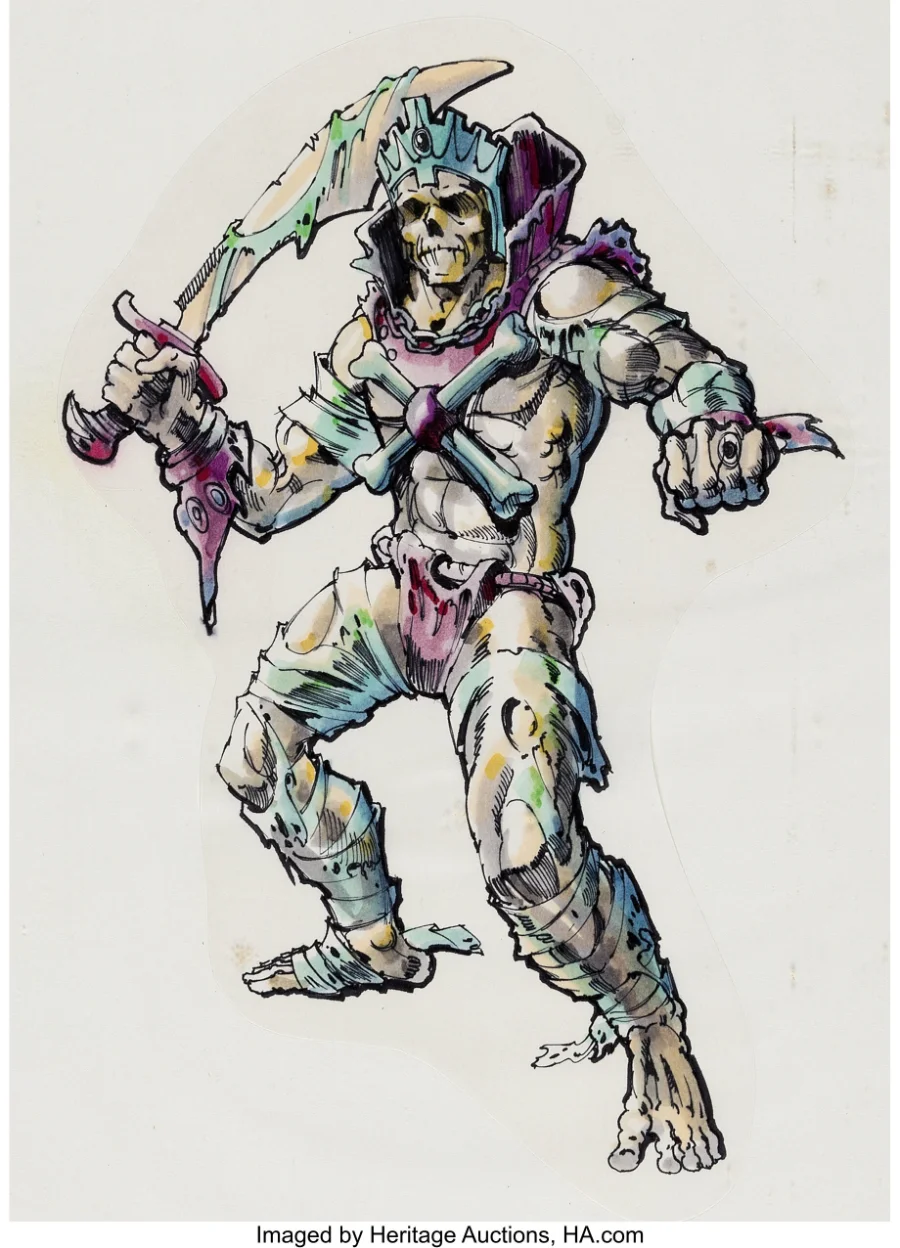
Masters of the Universe Skeletor (King of Styx) Original Concept Artwork by Mark Taylor (1970's). Emerging from the ancient depths of Mark Taylor's early fantasy mythos, the original concept artwork for what would evolve into Masters of the Universe's Skeletor-here titled Evil Incarnate, also known as The King of Styx-offers a chilling look at the skeletal sorcerer before he was fully bound to Eternia's canon. Rendered in mixed media on an illustration board with a clear protective overlay measuring 24 by 20 inches, this haunting piece predates Taylor's tenure at Mattel and stems from a story he wrote in college around 1971. At center stage, framed by a dramatic circular cut-out, stands a decayed monarch swathed in purple hues: a cracked, skull-like visage topped with a bluish crown embedded with a purple gem; a jagged purple neck collar, matching arm bracers, loincloth trunks, and mummy-wrapped legs terminating in exposed, desiccated feet. In his left hand he grips a tattered sword with a purple hilt-a weapon design Taylor would revisit in later illustrations, including his early versions of Skeletor, and one that curiously echoes in later artwork by Earl Norem.
Though not explicitly Skeletor, this "King of Styx" reveals a raw, foundational template-an undead warlord drawn from the underworld, cloaked in regalia and menace. Rebecca Taylor has confirmed that this design was one of several buried within a forgotten sketchbook recently unearthed during a garage repair, offering further insight into Mark's long fascination with skeletal royalty. Elements from this vision-particularly the face and crossbones motifs-would become cornerstones in the eventual design of Skeletor himself, as the idea shifted from standalone gothic horror to cosmic villainy. This early figure wasn't born from corporate branding; he was summoned from Taylor's personal mythology, where the boundaries between death, power, and fantasy blurred into legend.
This very artwork was later featured in the T. Mark Taylor - Sketches 1 print series, showcasing it to fans in its original form. It exhibits visible signs of age and studio handling, including toning, spotting, tape peeling on the edges, corner wear, surface scratches, and scattered scuffing. As the true original, this piece represents far more than a design experiment-it is the haunting seed of a mythology still echoing through decades of storytelling, collectibles, and cultural imagination.